Monday, 29 September 2014
Psycho (1960)
As you can see from above this is a review on the horror movie 'Psycho' which was made in 1960. I have uploaded a clip from Youtube which is the most famous scene from the movie, labelled the 'Shower Scene'. This links with the various results you find when typing into a search bar 'Psycho 1960'. The film was very unusual and I found it quite satire at times even though it wasn't supposed to be. Similar to many different horror movies, it was quite jumpy at times and I did feel myself on edge at various occasions. The fact that it was in black and white created suspense and I personally believe that this is what makes horrors even more scary. I was able to pick out the eight different characters in which refers to Propps theory. The character Marion Crane took on the role as the innocent girl and the psychopath Norman Bates was the villain. This was conspicuous throughout. Overall it was a good movie and a recommendation. The use of 'Psycho Strings' mad it even more scary.

Sunday, 28 September 2014
Propp's Character Theory
Vladimir Propp was a Russian and soviet formalist scholar.
Propp believed that there were 8 character main types. The emphasis was on looking at characters not as representing real people but as functions whose role was to move the narrative forward.
I personally agree with Propp's character theory as I can distinguish the eight different character types in films. Each character has a function that moves the narrative forward. I personally believe that the film will no be able to progress without it. All characters also have a main intention in which they want to achieve. For example in the 2009 horror movie, Orphan, Esther's main intention is to slowly kill off all of the family members, so that she can have a relationship with him. She uses her past experiences to convey this as she has had several sexual encounters with many men and getting raped young. She grows this fascination to act like a little girl and to get a family. Esther is the movies protagonist as well as the villain in which is a subversion as the hero of a movie is usually the main character. The hero in this case is the mother in the family Kate Coleman although it is not apparent throughout. She kills Esther at the end of the movie when she reveals herself as a 33 year old woman. The hero's helper is the little girl in the family, Max Coleman as she helps the family differentiate Esther's unpleasant ways which leads to her revealing her evil past. Stereotypically and according to Propp's character theory, Max supports her mother throughout the film to help her achieve the quest she has been set or given.
However, in the horror movie Carrie (1976), the eight different character types are not present. For example, Carrie is the main character of the movie and can be portrayed as the villain as she gets revenge by killing everyone. In this case, she could be viewed as the false hero, yet she does not try to steal anyone's thunder. This does not match Propp's character theory and goes against it as it can prove that Propp's character theory could be incorrect. Carrie also does not have a dispatcher that is prominent as all plans end up failing in the movie. The eight character theories may be there in the beginning, but end up being taken out of consideration. This can prove that Propp's character theory may not be reliable as I cannot distinguish the eight different character types in every horror movie. Not every character moves the narrative forward being labelled one of Propp's eight different character types.
Propp believed that there were 8 character main types. The emphasis was on looking at characters not as representing real people but as functions whose role was to move the narrative forward.
- The hero (seeks something) - on a quest, or trying to solve something.
- The villain - struggles against the hero.
- The princess/prize - an object which is deliberately sought by the hero. (She may be a reward).
- The Donor - a person who gives the hero something special (magical weapon).
- The Helper - The hero is supported in his or her quest by a helper.
- The Princess' father - Gives the task to the hero.
- The False hero - Appears to act heroically, tries to steal the hero's thunder.
- The Dispatcher - An early role in the story. The dispatcher sends the hero on a mission.
- The Rogue Hero - (Captain Jack Sparrow) Not the most villainous or the most heroic character, so could be termed as a rogue.
I personally agree with Propp's character theory as I can distinguish the eight different character types in films. Each character has a function that moves the narrative forward. I personally believe that the film will no be able to progress without it. All characters also have a main intention in which they want to achieve. For example in the 2009 horror movie, Orphan, Esther's main intention is to slowly kill off all of the family members, so that she can have a relationship with him. She uses her past experiences to convey this as she has had several sexual encounters with many men and getting raped young. She grows this fascination to act like a little girl and to get a family. Esther is the movies protagonist as well as the villain in which is a subversion as the hero of a movie is usually the main character. The hero in this case is the mother in the family Kate Coleman although it is not apparent throughout. She kills Esther at the end of the movie when she reveals herself as a 33 year old woman. The hero's helper is the little girl in the family, Max Coleman as she helps the family differentiate Esther's unpleasant ways which leads to her revealing her evil past. Stereotypically and according to Propp's character theory, Max supports her mother throughout the film to help her achieve the quest she has been set or given.
However, in the horror movie Carrie (1976), the eight different character types are not present. For example, Carrie is the main character of the movie and can be portrayed as the villain as she gets revenge by killing everyone. In this case, she could be viewed as the false hero, yet she does not try to steal anyone's thunder. This does not match Propp's character theory and goes against it as it can prove that Propp's character theory could be incorrect. Carrie also does not have a dispatcher that is prominent as all plans end up failing in the movie. The eight character theories may be there in the beginning, but end up being taken out of consideration. This can prove that Propp's character theory may not be reliable as I cannot distinguish the eight different character types in every horror movie. Not every character moves the narrative forward being labelled one of Propp's eight different character types.
Tuesday, 23 September 2014
Deconstruction Of 3 Horror Movie Posters
Annabelle (2014)

As you can see from above, 2014 horror movie 'Annabelle' uses a lot of horror conventions. The title conveys death and blood giving the fact that it's in red. I also picked out the fact that the picture is of a doll/girl which can exemplify innocence being corrupted. I have noticed over time that a main convention in a horror movie is to use a child as they are usually the pure ones. Due to their innocence as they are young, they get corrupted and become an evil being destroying those around them. Annabelle's poster is really interesting as the background is all black and then you have this daunting image of a doll/girl with only half of her face showing. This can also indicate that she has two sides two her, one being pure and the other being this violent evil being. She has a tear streaking down her face which is unusual as the tear is blood, this is creepy and can attract various audiences to watching it. They also feature 'The Conjuring' on the front of the poster which is also another horror movie, this will attract a wider audience.
Paranormal Activity - The Marked Ones (2014)

Paranormal Activity also has a black background which conveys the fact that it is nighttime, therefore no one is around to help the character that is being tortured or believe that they are seeing something. Also at night you lose some of your senses, so your mind can be playing tricks on you. I found this poster really fascinating as it conveys religion being corrupted or rebelled against. The image is suppose to be of Jesus praying, instead there is a Grim reaper as the face which is significant of death. 'The marked ones' could link to 'The chosen ones' which is also another connotation of religion. There is a religious symbol on the Grim reapers head, which is a circle inside a triangle. This symbol represents the Trinity of the Father, Son and Holy Spirit, this presents 'One God'. They have used religion to be manipulated which can foreshadow that the film will not run smoothly or go accordingly to plan. Something bad is bound to happen. The Grim reaper is also not looking at the camera, this can suggest eeriness and fear as you don't know what will happen if you have eye contact.
Apocalypse (2014)

I automatically found that this horror movie poster was a subversion as there is a woman on the front cover. She looks like a stereotypical woman as she is wearing fitted clothing. She is also a male gaze. As she is holding some sort of weapon, this conveys that there is a dark side to her and she does not meet the general stereotype of the petrified woman in horrors. The look on her face is sinister and as she is shot from an over the shoulder shot, this can suggest that she has something to hide, linking back to the Annabelle poster of the doll/girl having two sides to her. The camera is also slightly tilted upright to give the woman authority and power over viewers. This exemplifies that she is the movies protagonist as she is a dominant character. The background is black and red which are stereotypical colours of the horror genre. The red connotes blood and the black connotes darkness or danger. The title 'Apocalypse' is animated in a yellow colour which looks like fire. This can foreshadow later events in the film which can portray torture or death.
Sunday, 21 September 2014
Let The Right One In Review (2008)
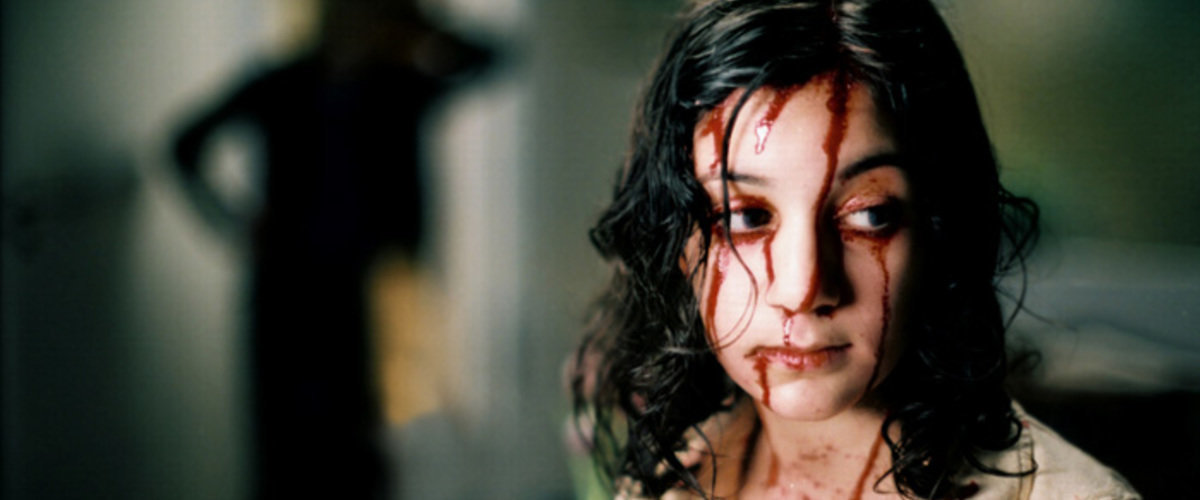
Stereotypically of a vampire film, Let the right one in is very dramatic and gory. Again stereotypically, there is a boy that is bullied and becomes the superior person towards the bully. When watching the film from the start, I genuinely did think that the film was going to be boring as it was in sub-titles and it took a while for some action to commence. An hour into the film, I began to start enjoying it as I knew the baseline of the story and could kind of predict what will happen to each character. The character Eli was a subversion as she was the last girl standing and the vampire. Not in many vampire films you find a girl having authority over the rest of the characters. Also what I liked about the film is that it was from a child's perspective as he is followed throughout his life from growing up on an estate being bullied (which is another subversion), to him over powering the bullies which the help from the girl who is a vampire. Oskar befriends Eli and they become the unlikely best of friends. There are a lot of dark scenes in which some viewers may find hard to watch. A lot of scenes which involve decapitation are present which links to the general stereotype of blood and gore.
Vampire Films
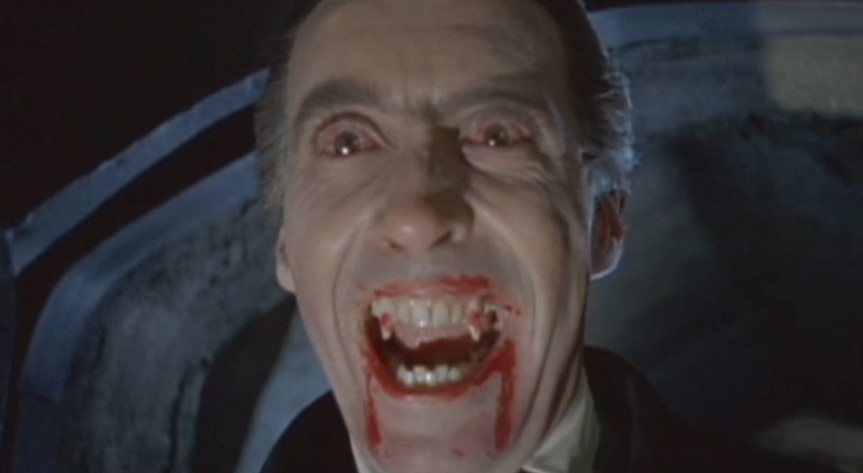
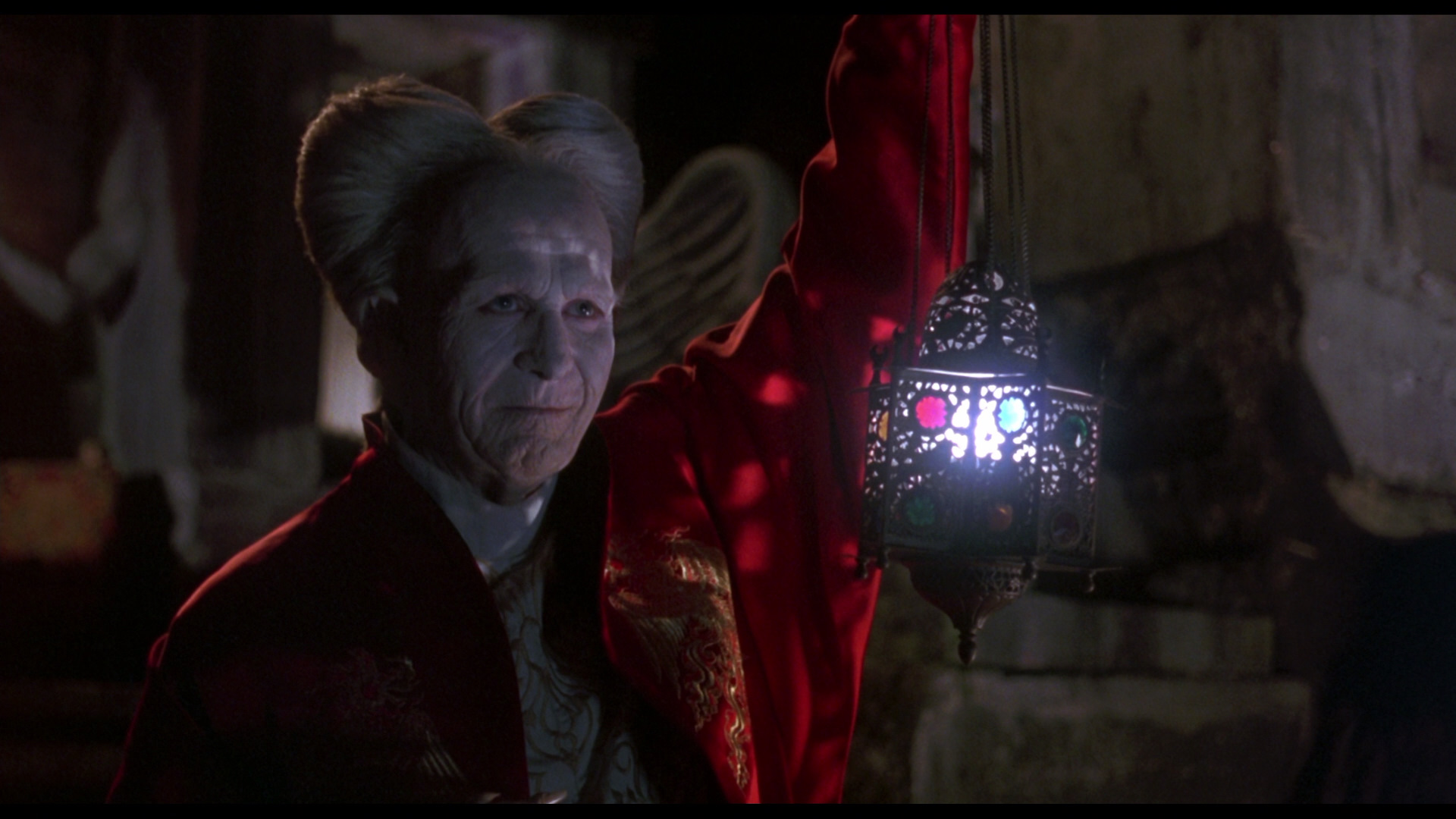
In last weeks lesson, we looked at four different vampires in horror films over time. The first clip we watched was from a vampire film called 'Nosferatu' which came out in 1922. Stereotypically of a vampire, he had dark eye make-up, lived in an isolated area and was hideous to look at. When the camera was focused on the vampire, the music automatically became eerie and sinister which had connotations of the fact that the vampire is evil and stereotypically sucks human blood. Nosferatu is a foreigner, therefore he is 'out of place' and classed as the 'other'. This again links in to the stereotypical aspects of a vampire as he is not like everyone else. We also looked at a horror movie named 'Horror of Dracula' which came out in 1958. Sinister music was played just like in Nosferatu when the vampire entered connoting death and the 'other'. The vampire was shot from many low angles which conveyed power and authority in which he had. As a subversion, the vampire looked more human as he was portrayed as a 'heartthrob' having many sexual encounters with women. Again he was a foreigner which is similar to 'Nosferatu'. He also stereotypically lives in a coffin as he hates daylight as he will melt as he is a vampire. The third vampire movie we looked at was the 1992 version of 'Dracula' starring Gary Oldman. In this version he is very theatrical which is similar to both vampire films, Nosferatu and Horror of Dracula. Most scenes are shot through a red filter which implies blood and gore which is a stereotype of a vampire. In contrast we sympathise with this vampire as we see his background story of why he is the way he is. In most vampire films there is no background story, the vampires are just evil. In contrast to the three other vampire stories we watched, we looked at Twilight (2008-12). Twilight is a subversion to stereotypical vampire movies as the vampires in the film have good morals, dress all in white and live in a house well lit. Unlike Nosferatu, the vampires in Twilight are beautiful and attractive. The movie subverts from the general stereotype of a vampire, but then keeps to the stereotype as the vampires are fast, robotic and pale.


Sunday, 14 September 2014
Analysing A Horror Movie

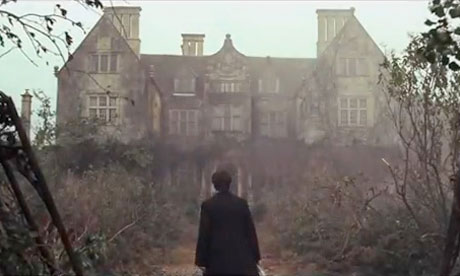
I didn't expect the movie to be as scary as it was as it is an English movie and I personally believe that American movies are a lot more scary.
The Woman In Black Analysis (2012)
Above, I have analysed the 2012 horror movie, The Woman In Black. I have spoken about what makes it a horror and stereotypical aspects the movie has used to fit that particular genre. I explore in depth about why people enjoy watching horrors and what drives people away from watching horrors. Overall, I really enjoyed the movie even though there were many scary parts and the fact that I'm not a huge fan of watching horrors myself.
The Conjuring Analysis (2013)

Here is a trailer from 'The Conjuring' in which is a horror movie. I watched this film last summer and was scared out of my wits! It is definitely a jumpy horror film as you are constantly on edge as a lot of tension is constantly built up. It is worth watching for a horror lover! I did notice that in horror movies they do generally like to use children which implicate their innocence being corrupted. The children are usually symbols of purity and religion is a huge aspect in horror movies. Many scenes are shot in the dark which create more sense of something bad about to happen or connotations of death. Many horror movies are shot at night as that is the time people lose their senses so they make out that they are seeing things and also no one is around at night to save them. I felt that 'The Conjuring' used this general stereotype which made the film even scarier.
Wednesday, 10 September 2014
Introduction
Hello, this is my first blog post of September 2014. I have officially started A2 media and the basis of the course is to look at the horror genre which I am really looking forward to researching. I'm going to admit that I am not an entirely massive fan of the genre, would say that on a scale of 1-10, I'm a 5 when it comes to watching horror. Over the year, that could all change and I can hopefully enjoy the genre a lot more...who knows?
Subscribe to:
Comments (Atom)